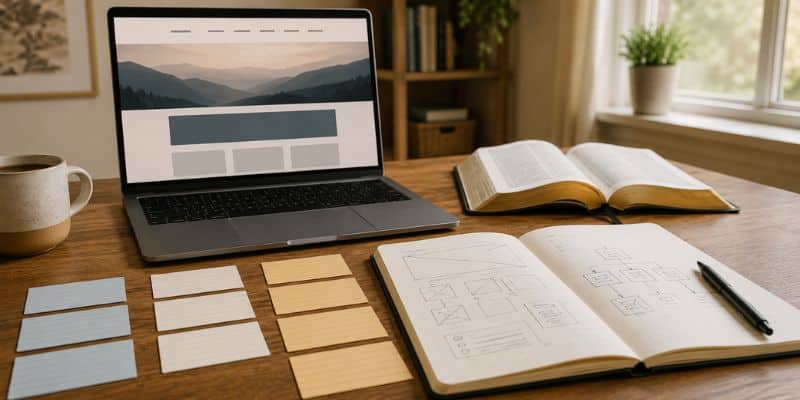
What to do before starting a website begins with slowing down long enough to plan it. Decide why the website should exist, who it will help, what you want it to become, and what you are willing to invest. If you are building a Christian website, spend time in prayer before making those decisions.
Part of our guide to How to Plan a Christian Website.
Before You Plan Anything, Pray About It
If you are actually a Christian and you are thinking about starting a Christian website, there is one step I would put ahead of everything else.
Pray about it.
That applies whether you hope the website eventually makes money or you simply want a place to teach, encourage, share your experience, or help other people.
Before choosing a domain name, buying hosting, picking a platform, or deciding what your website will look like, spend some time asking God whether this is something you should do and what He wants you to accomplish through it.
That does not mean you should expect God to tell you which hosting company to use or what color your website should be.
It means settling the bigger questions first.
Why are you doing this? Who are you trying to help? What do you have to offer them? Is this something you are willing to stay with when the excitement of starting wears off?
Letting God lead you through those questions can remove a great deal of indecision later. It gives you something solid to come back to when you begin wondering whether you chose the right direction or whether the work is worth continuing.
Starting with prayer also helps keep the website from becoming the goal itself.
The website is only a tool. What you hope to accomplish through it is what matters.
Starting a Website Involves More Decisions Than You Think
One thing I wish more people told beginners is just how many decisions are involved in starting a website.
From the outside, it can look simple.
Buy a domain name. Get hosting. Install WordPress or choose a website builder. Pick a design. Start writing.
That sounds like an afternoon.
It usually isn’t. It’s usually much longer than that when you consider it from the starting gun to the “Ah, that’s it!”
Before long you are deciding what the website is actually about, who it is for, how broad the subject should be, what to call it, which domain extension to use, which platform to build it on, which hosting plan you need, what pages belong on it, how the navigation should work, what categories you need, what theme to use, and which plugins or services are actually necessary.
Each decision creates another one.
That does not mean starting a website has to be overwhelming. It means you should expect the planning to be part of the work.
Planning a Website Is Not Wasted Time
It can feel like you are accomplishing nothing when you spend a few days thinking instead of building.
But the thinking and the planning is the key to best outcome possible.
You may accomplish more with an hour spent making the right decision on paper than with several hours spent building something you later have to undo.
Many website decisions can be changed.
You can change your theme. You can reorganize your categories. You can move to another host. You can rewrite pages. You can even change your entire website platform.
But being able to change something does not mean changing it is painless.
The biggest loss often isn’t money.
It is time.
You may spend an entire weekend learning how to do something one way, only to discover that you chose the wrong approach and have to start again.
That gets old very quickly.
Get a Notebook Before You Start Building
This may sound almost too simple, but I recommend getting a notebook before you start your website.
Not another browser tab.
A notebook.
Paper, pens, pencils, and even a stack of notecards can be surprisingly useful when you are trying to see how the different parts of a website fit together.
As you work through the planning process, write things down.
Write down the reason you want the website. Write down the people you hope to reach. Make a list of possible subjects. Sketch out categories. Write possible domain names on separate cards. Cross things out. Change your mind.
That is what the paper is for.
Nothing you write in that notebook has to be permanent.
The point is to make your decisions visible before you turn them into a website.
Use Each Step to Make One Real Decision
The guides on this site are arranged in an order for a reason.
You do not have to read everything on the website before you begin. But as you move through the process, give yourself enough time with each subject to actually think about what it means for your website.
When you read about defining the purpose of your site, stop and write down what you think its purpose is.
When you get to choosing a niche, work through your possible niches.
When you start thinking about your audience, describe the person you hope will find your website useful.
Later, when you reach domain names, platforms, hosting, themes, pages, and navigation, do the same thing.
You do not need hours for every article.
Sometimes ten or fifteen minutes may be enough.
But that small amount of deliberate thought can keep you from rushing into a decision simply because the first option you saw looked good.
Don’t Spend Money Just Because Someone Says You Need Something
Another lesson worth learning early is that starting a website gives people plenty of opportunities to sell you things.
Some of those things are useful.
Some are excellent.
Some you probably do not need at all.
It is easy for a beginner to believe that every premium theme, SEO tool, security service, page builder, email service, backup service, optimization plugin, AI tool, or website package is something a serious website owner is supposed to buy.
That can get expensive.
The larger problem is that you may spend money before you even understand what problem the product is supposed to solve.
Learn what you need first.
Then buy the thing that solves that need.
You do not have to build the ultimate version of your website on the first day.
Be Careful With Free Website Options Too
Free website builders and free plans can be useful if you simply want to experiment and see whether you enjoy building a website.
But free does not necessarily mean there is no cost.
Sometimes the cost is your time.
A free service may limit your domain, storage, design options, plugins, features, or control over the website. Those limitations may not matter while you are experimenting.
They can matter a great deal once you become serious.
The frustrating part is discovering that after you have already spent days learning the platform and building the site.
You may then have to move everything, rebuild pages, learn another system, or start over entirely.
That is why it helps to decide early whether you are just experimenting or whether you genuinely intend to build a website that you hope to keep for years.
If you are serious about it, plan with the long term in mind.
Decide How Serious You Are Before You Invest
You do not need to spend a fortune to start a website.
But a serious website will usually require at least some investment.
A domain name costs money. Good hosting costs money. Depending on what you build, you may eventually decide that a paid theme, plugin, service, or other tool is worth purchasing.
Before spending anything, ask yourself how committed you are to the idea.
Would you still want to work on this website six months from now?
Are you interested enough in the subject to create dozens of useful pages or articles?
Are you willing to spend time learning things that have nothing to do with writing, such as WordPress, hosting, security, backups, or search engines?
There is nothing wrong with deciding you are not ready.
Finding that out before spending money and weeks of your time is much better than finding it out afterward.
Don’t Confuse Planning With Trying to Make Everything Perfect
There is another extreme to avoid.
You can plan forever.
At some point, you have to build the website.
The purpose of planning is not to eliminate every future mistake. You won’t.
You are going to change your mind about some things. You are going to learn something six months from now that you wish you knew today. You may buy something you later decide you did not need.
That is part of learning.
The goal is simply to avoid the mistakes you could have prevented by thinking for a few minutes before making the decision.
You do not need a perfect plan.
You need a good enough plan to begin moving in the right direction.
Expect the Website to Change as You Learn
Your first idea for the website may not be exactly what it becomes.
That is normal.
As you begin publishing content and seeing what people respond to, you may discover that one part of your subject deserves more attention than another. You may find that your audience is slightly different from the people you originally imagined.
You may even decide that something you thought was essential doesn’t matter very much.
Planning gives you a starting direction. It does not lock you into every decision forever.
The difference is that you are making those early decisions intentionally instead of randomly.
What Should You Have Decided Before You Start Building?
You do not need every detail settled before you start.
But you should have a reasonable understanding of why the website exists, who you want it to help, what general subject it will cover, and whether you are willing to invest the time and money required to keep it going.
Those decisions make the later choices easier.
A domain name becomes easier to choose when you know what the site is about. A platform becomes easier to choose when you know what you need the website to do. Categories become easier to plan when you understand your subject. Content becomes easier to create when you know whom you are writing for.
That is why the planning comes first.
Take Your Time Before You Click “Buy”
Starting a website can be exciting.
That excitement can also make you want to get everything set up immediately.
Resist that urge for a little while.
Pray about what you are doing. Get a notebook. Think through the purpose. Consider the people you want to help. Work through the major decisions one at a time. Learn enough about each choice to understand what you are committing yourself to before you spend money or hours of your time on it.
You will still make mistakes.
Everybody does.
But if you do some serious thinking before you start building, you can avoid a surprising number of headaches, wasted purchases, and hours spent rebuilding things that could have been worked out on paper first.
Then, when you finally start building, you will not just have an idea for a website.
You will have a plan.